Celebrating the birth of Jeconiah’s seed, Jesus Christ
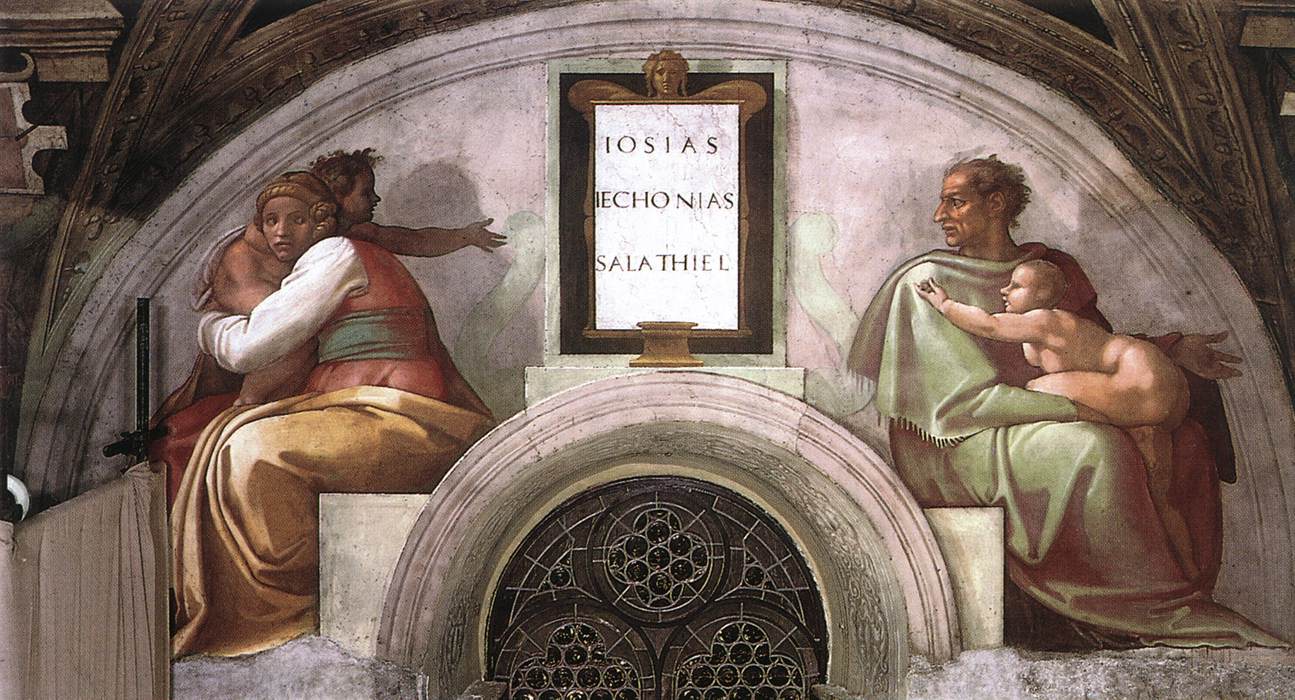
Ancestors of Christ: Josiah, Jeconiah, Shealtiel / Michelangelo. 1511 or 1512
Who is Jeconiah? We find him in the first chapter of Matthew:
And Josiah the father of Jeconiah and his brothers at the time of the exile to Babylon.
After the exile to Babylon: Jeconiah was the father of Shealtiel, — Matthew 1:11-12 BSB
So he’s in Jesus’ genealogy, but so are a lot of other people known only by being in genealogical lists. Let’s look further.
“As surely as I live,” declares the Lord, “even if you, Coniah son of Jehoiakim king of Judah, were a signet ring on My right hand, I would pull you off. In fact, I will hand you over to those you dread, who want to take your life—to Nebuchadnezzar king of Babylon and to the Chaldeans. I will hurl you and the mother who gave you birth into another land, where neither of you were born—and there you both will die. 2You will never return to the land for which you long.”
Is this man Coniah a despised and shattered pot, a jar that no one wants? Why are he and his descendants hurled out and cast into a land they do not know? O land, land, land, hear the word of the Lord! This is what the Lord says: “Enroll this man as childless, a man who will not prosper in his lifetime. None of his descendants will prosper to sit on the throne of David or to rule again in Judah.”– Jeremiah 22:24-30
We see that Jeconiah, here somewhat derisively called simply Coniah, is actually Josiah’s grandson and that he will not prosper. The historical books in the Old Testament give the details on how it worked out.
Jeconiah/Jehoiachin in the historical record
Some translations use the name Jechoiachin in Matthew’s genealogy. Perhaps Jeconiah was a personal name and Jehoiachin a throne name. According to 2 Kings 24:6-16 and 2 Chronicles 36:9-10, Jehoiachin became king at the death of his father Jehoiakim and reigned for three months. Then he surrendered to Nebuchadnezzar, who deported him to Babylon.
Nebuchadnezzar installed Jehoiachin’s uncle Mattaniah as king and gave him the throne name Zedekiah. Eleven years later, Jeremiah counseled Zedekiah to follow Jehoiachin’s example and surrender to Nebuchadnezzar. Instead, he tried to flee Jerusalem with his family. The last thing he ever saw was Babylonian troops slaughtering his sons. Then, they put his eyes out and carried him to Babylon, where Jeconiah/Jehoiachin already was.
The Bible isn’t finished with Jeconiah’s story. In 2 Kings 25:27-30 and Jeremiah 52:31-34, a new king of Babylon released him from prison and made him a permanent guest at his table.
What does it all matter, really?
The Babylonians took Jeconiah to Babylon along with thousands of other people. In Ezekiel 11:1-4, the Spirit of God had carried Ezekiel to Jerusalem, where he heard someone saying that Jerusalem was a pot and residents of Jerusalem were the meat in it, as if the exiles were somehow rejected of God. In fact, God had sent the best, not the worst people into exile.
When the Babylonians slew Zedekiah’s sons, it looked like the end of the House of David. It was the second time it appeared that David’s line had run out.
The first time, Queen Athaliah murdered all her grandsons, apparently intending to replace David’s dynasty. One of her granddaughters rescued baby Joash, who became the next Davidic king. God promised David an everlasting dynasty, and no human power can get in his way.
And now, let’s not forget Jeconiah. As far as the Old Testament is concerned, he amounts to nothing more than a footnote in history, at best a failure. He spent most of his life in a Babylonian prison, but he had at least one son, who had at least one son, etc. The genealogy of David stretches all the way to Jesus.
Isn’t that just like God? He remembers people the world forgets. A man who seems like a failure? A man Scripture calls a bad king after only a three-month reign? God highly exalted him, at least enough to take his place in the genealogy of Jesus Christ.
Whatever in human terms seems insignificant might be very important indeed.
Comments
Celebrating the birth of Jeconiah’s seed, Jesus Christ — No Comments
HTML tags allowed in your comment: <a href="" title=""> <abbr title=""> <acronym title=""> <b> <blockquote cite=""> <cite> <code> <del datetime=""> <em> <i> <q cite=""> <s> <strike> <strong>